
In September, U.S. News & World Report released its 2027 edition of Best National Universities. The rankings featured some major shifts, alongside a major change in methodology.
The 2027 U.S. News Rankings Favored Private Universities
One of the most significant changes in the rankings is a general (though not universal) drop in the rankings for public universities, along with a general gain for private nonprofit ones.
For example, UC Berkeley dropped five spots, from #15 to #20. By contrast, CMU rose six spots, from #20 to #14.
Like Berkeley, many other public universities fell. UCLA fell three spots, the University of Washington fell seven spots, and Purdue fell nine spots, to name just a few.
Rising with CMU were the private universities WashU (+4 spots), Tufts (+5 spots), and Villanova (+15 spots).
More broadly, for the top 100 U.S. News schools, which included 49 public universities and 59 private ones, 30 of the 49 public universities moved down, while 38 of the 59 private universities moved up. (Because of ties at #100, there are 108 schools in the top 100.)
The average gains and losses tell a similar story. Within the “Top 100” schools, the average public school fell 2.4 places, while the average private school rose 3.7 places.
(By the way, for 2027, U.S. News did shift additional schools to the national universities list that were not on it in 2026. These new schools that I identified, however, were all ranked #137 or lower, so their arrival did not change the rankings of the Top 100.)
U.S. News Replaced Student Debt With Graduate Earnings
This pattern of losses for public colleges and gains for private ones seems linked to an important change in methodology: U.S. News replaced levels of graduate debt with levels of graduate income. Both factors received a ranking weight of 5%.
Intuitively, one can see why this change produces an advantage for private colleges. Because public colleges are less expensive than private ones for in-state students, their graduates often carry less federal debt than do students at private colleges. The old metric of student indebtedness thus tended to benefit public colleges.
The data do strongly suggest the significance of the shift from measuring graduate debt to measuring graduate income. With the help of ChatGPT, I dug into the National College Scorecard, the data sets used by U.S. News to calculate graduate debt and graduate income. The full story is a matter for another day, but a single example will help to illustrate the point.
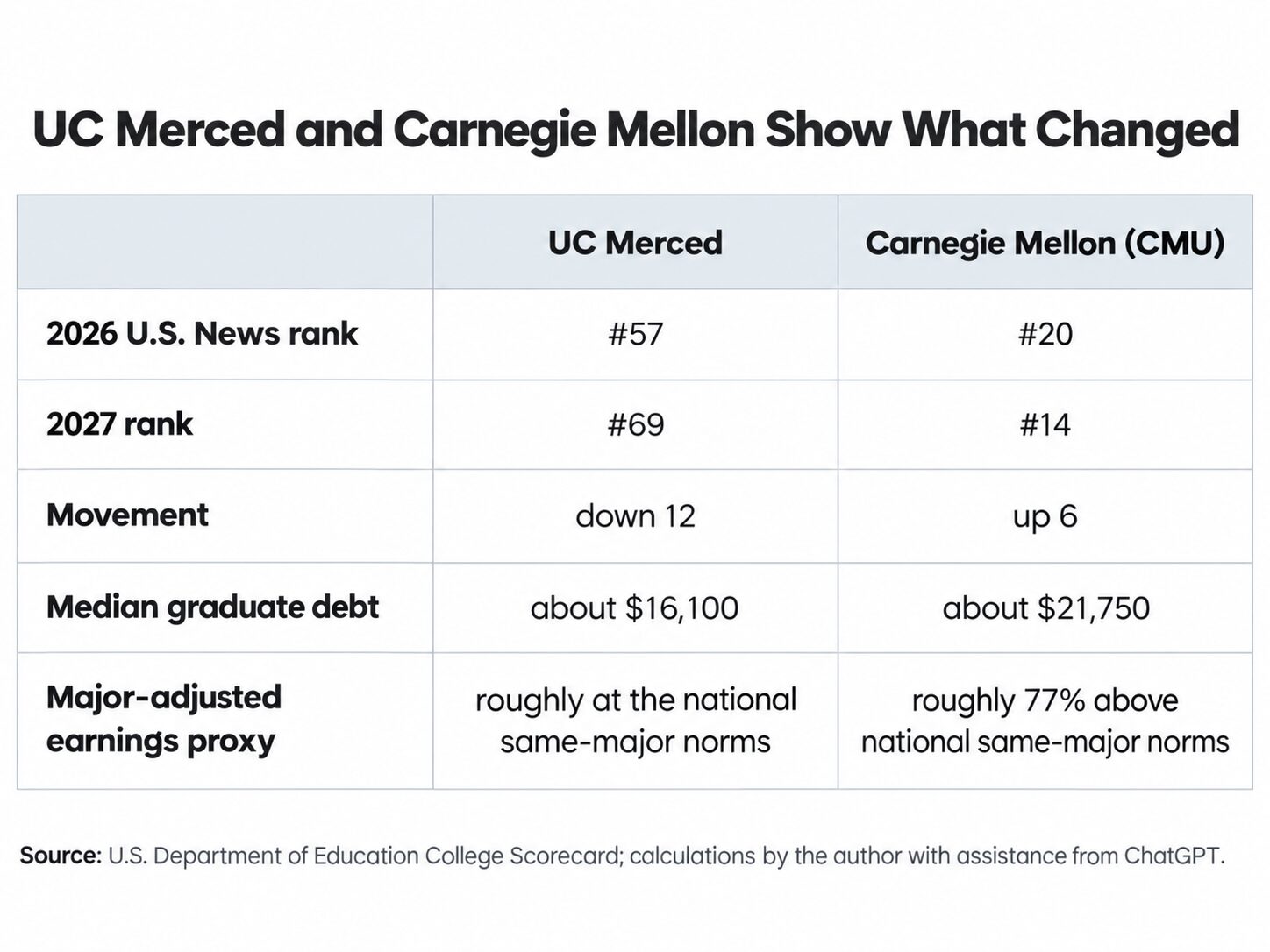
Compared to CMU, UC Merced has a favorable median graduate debt, which presumably helped it when U.S. News included debt in its metric. But by contrast, CMU has a much more favorable position for same-major earnings. In the new system, that gives it a strong advantage over UC Merced, potentially contributing to the 18-point widening of the gap between their rankings.
By the way, the geography of wage earnings does not appear to explain the changes in ranking. When I examined the data, I saw no difference between colleges located near high-wage Silicon Valley and colleges located near low-wage cities in the South. Among private universities, the average gains in ranking were substantially the same, regardless of campus location; likewise, the losses for public universities were substantially the same, regardless of location.
Do Higher Alumni Salaries Mean a Better College?
Does this result show that private universities are better than publics at elevating alumni salaries?
Not necessarily; that’s because earnings, even categorized by major, are not solely dependent on the college from which a student graduates. For example, one important contributing factor to earnings is family income: students from wealthy families tend to earn more than students from low-income families. And wealthy families are better able to afford the price-tag of a private university.
High salaries from private school graduates, then, might simply reflect the high family income of students attending those schools.
Public Universities Benefited From the 2024 Rankings Change
This change in the rankings doesn’t necessarily reflect a sudden change in the value of education at public universities. Historically, public universities like Berkeley and UCLA were typically ranked lower in U.S. News than they were in the period 2024 to 2026. Prior to 2024, U.S. News took into consideration factors like alumni giving, class size, high school class standing, and the share of graduates who borrowed federal loans—measures that tended to benefit private universities, in part due to their wealthier students.
For the 2024 rankings, U.S. News eliminated several of these categories and gave increased weight to student outcomes, including “social mobility,” which it had typically measured by calculating the graduation rate of students receiving federal Pell Grants. These new emphases seem to have benefitted public universities, though it’s hard to isolate exactly why. What is clear is that the new metric produced remarkable leaps for public universities in the 2024 rankings—from #20 to #15 for Berkeley, from #20 to #15 for UCLA, from #51 to #43 for Purdue, and from #67 to #47 for Texas A&M.
In a way, then, this latest shift in methodology, which has apparently lowered the rankings of public universities, has simply adjusted many of them back towards the parts of the rankings that they occupied prior to the 2024 change.
What the Rankings Don’t Tell You
It’s important to take all ranking systems with a grain of salt. The differences between a school ranked #8 and a school ranked #12 appear significant on a rankings scale, but their ranking score can be separated by tenths or hundredths of a percent. Also, national rankings fail to capture the strengths of specific majors; the University of Washington is ranked #49 nationally, and Yale is ranked #4, but the CS program at UW is ranked higher than that of Yale on the U.S. News CS rankings. I’ve written extensively about this phenomenon and others for my company newsletters and plan to publish updated versions of this analysis online later this fall.