
Danger Ahead
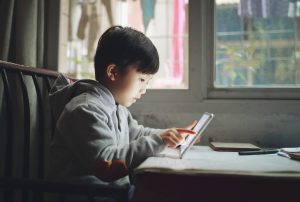
Recently, I had a webinar with some IYE parents about what they can do to support their kids’ reading and writing. One parent mentioned iPads in the schools. Apparently, her son is in 6th grade, and his private school has given each child an iPad that will be required for some school assignments, including reading.
As a teacher and a parent, I’m very concerned about this development. I don’t think it’s a good idea to encourage children to read with screens instead of books. There is a lot of scientific evidence that reading on screens is bad for learning.
I covered some of the evidence in Read Better—Forever, our ebook on how to improve reading. The following section is taken directly from the ebook.
According to Scientific American, “screens may…drain more of our mental resources while we are reading and make it a little harder to remember what we read when we are done .”
The same article notes that “getting away from multipurpose screens improves concentration.”
The same article adds that when people read on computers, they don’t try as hard; they tend to look for shortcuts and skim.
One fascinating study made students responsible for managing their own study time; the ones who used a physical book “scored about 10 percentage points higher” on a test than the ones who read from a computer screen.
To sum up, using paper books
- improves the speed at which students learn
- improves concentration
- discourages bad habits like skimming
- can improve test performance.
Why might this be? The article in Scientific American covers that answer in more depth. However, one of the more important advantages of paper texts is physical presence. First, paper books provide a sense of physical location on the page: “we remember that we read about Mr. Darcy rebuffing Elizabeth Bennett on the bottom of the left-hand page in one of the earlier chapters.”
In addition, the feel of paper adds an important element to the reading experience: “People expect books to look, feel and even smell a certain way; when they do not, reading sometimes becomes less enjoyable or even unpleasant.”
There are other reasons to be concerned about shifting student reading to iPads. An iPad is a device that easily converts from reading to playing games. When the child is reading, he will be thinking about how soon he can switch the device to game mode. This attitude makes it harder for him to become absorbed in the book.
How many of you, when working on the computer, have had to fight the temptation to switch to a news or social media website? I know I fight this temptation daily. Maybe I’m not playing games, but I am distracting myself from my work. Imagine how this temptation will affect kids, who are naturally more prone to distraction.
A decade ago, Nicholas Carr published the breakthrough article “Is Google Making Us Stupid?” In that article, he suggested that web-based reading weakened the architecture of the brain, making it harder for people to understand complex sentences. A lot of people reading with electronic browsers have reported similar feelings. The articles I’ve referenced in Time and Scientific American provide scientific support for Carr’s anecdotal observations.
Based on my personal experience and the scientific evidence, I’ve drawn a firm conclusion about screen-based reading in schools. If my son is asked to use an iPad in school, I’m going to push back. At the very least, I will ask the school to make paper copies of materials available for all parents who prefer for their kids to use them.